
The chemical industry plays a crucial role across nearly all sectors of the economy — from industrial manufacturing, agriculture, and pharmaceuticals to materials and energy. However, as the world undergoes a profound transformation toward a greener and more sustainable future, the chemical industry is also experiencing a period of significant change.
Factors such as sustainability, digital transformation, innovation, and environmental safety are reshaping the entire chemical value chain — from research and production to distribution. Companies in the industry are not only required to enhance efficiency but also to adapt to new demands related to social responsibility, environmental standards, and advanced technologies.
In this context, staying updated on the latest trends in the chemical industry enables businesses to set strategic directions, develop suitable products, and maintain a competitive edge in today’s rapidly evolving market.
1. Green Chemistry – New Applications in the Chemical Industry
According to United States Environmental Protection Agency, green chemistry involves the design of chemical products and processes that minimize or eliminate the use and generation of hazardous substances. It is applied throughout the entire life cycle of a chemical product — from design and manufacturing to use and final disposal.
Green chemistry helps reduce pollution at its source by limiting or removing hazards associated with raw materials, reagents, solvents, and chemical products.
This approach differs from pollution treatment (also known as remediation), which deals with waste streams or cleans up chemical spills and emissions after they have occurred. Most remediation activities are not considered part of green chemistry. While remediation focuses on removing hazardous substances already present in the environment, green chemistry aims to prevent their creation in the first place.
However, if a technology reduces or eliminates the use of toxic chemicals for cleaning up pollutants in the environment, it can also be regarded as a green chemistry technology.
For example, instead of using a harmful adsorbent to capture mercury from the air, a safer yet equally effective adsorbent could be used. This eliminates the need to produce the toxic adsorbent in the first place — thus making the technology an example of green chemistry, as it prevents hazardous substances from being generated.

2. Applications of Artificial Intelligence in the Chemical Industry
According to an analysis published in Science (2024), digitalization is propelling the chemical industry into a new era — the era of sustainable chemistry. With its ability to process massive volumes of data, Artificial Intelligence (AI) enables researchers to predict reactions, simulate processes, optimize production conditions, and even propose entirely new chemical formulas that humans have never conceived of before.
The adoption of technologies such as Digital Twin, IoT, and Big Data analytics allows companies to precisely measure energy consumption and emissions, and automatically adjust operations to minimize waste at every stage of production.
AI not only accelerates research but also transforms the way the chemical industry operates. Through machine learning and predictive modeling, AI can identify more efficient catalysts, lower reaction temperatures, and significantly reduce energy consumption. In production, automated systems collect data from thousands of sensors, detect process deviations early, and prevent product defects and material waste.
The chemical supply chain, known for its complexity and vulnerability to global disruptions, also benefits greatly from AI. Demand forecasting, smart inventory management, and optimized logistics enable companies to reduce costs, minimize risks, and respond more quickly to market changes.
More importantly, transparent and traceable data help companies comply with ESG (Environmental – Social – Governance) standards — now becoming mandatory for accessing major markets such as the EU and the United States.
Chemical companies worldwide are ramping up investment in AI. Nearly three-quarters of industry leaders plan to spend over USD 100 million on developing AI-driven products before 2025.
Some notable examples include:
-
Entalpic, a UK-based startup, raised €8.5 million to research AI-powered carbon removal technologies.
-
In the United States, Albert Invent secured USD 22.5 million to develop an R&D platform that enables chemical companies to create new products faster and test them more efficiently.
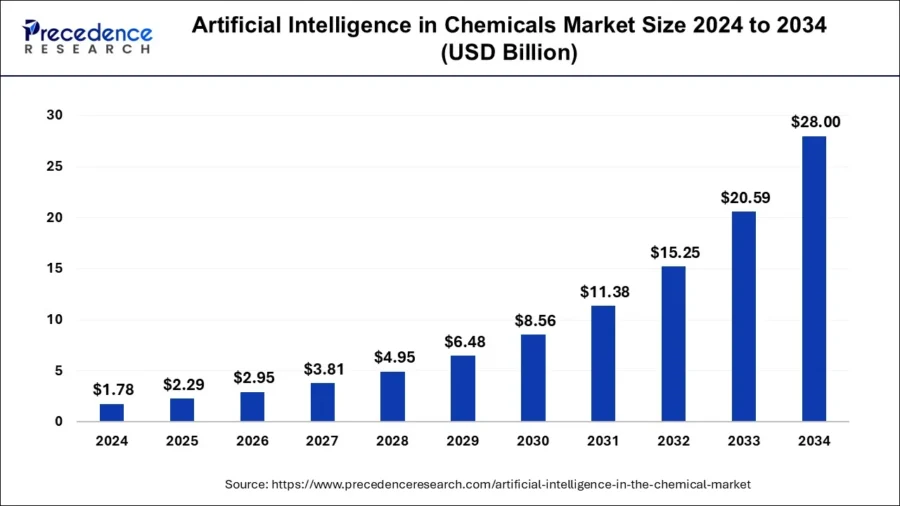
The global AI in chemicals market is expanding rapidly — projected to reach over USD 1.4 billion by 2025, and nearly USD 13 billion in the coming years, with the U.S. accounting for the largest share at around USD 9 billion by 2034.
For Vietnamese enterprises, digital transformation doesn’t necessarily have to start with large-scale projects. A smart first step is to focus on a specific process — for example, optimizing reactions, reducing electricity consumption, or monitoring product quality — and then applying sensor systems and data analytics to measure performance. Once clear results are achieved, companies can expand these initiatives to other departments.
At the same time, it is essential to build a centralized data infrastructure, train internal staff in digital technologies, and foster collaboration between chemical engineers and AI specialists.
Finally, sustainability should be integrated into the long-term strategy — from selecting eco-friendly raw materials and designing recyclable products to transparently disclosing emission data.
3. IoT Integration in the Chemical Industry
According to StartUs Insights, the adoption of the Internet of Things (IoT) in the chemical industry is growing rapidly. The global market size is expected to increase from USD 97.9 billion in 2025 to USD 217.91 billion by 2029, representing a compound annual growth rate (CAGR) of 22.1%.

North America currently leads this trend, accounting for over 40% of the market share in 2024, equivalent to more than USD 31.76 billion in revenue.
This indicates that chemical companies are increasingly relying on IoT technologies to move toward smarter, safer, and more efficient production processes.
However, the industry also faces several challenges. One major issue is the growing risk of cybersecurity threats, as more devices and systems become interconnected. In addition, the high initial investment costs required for purchasing IoT equipment, integrating systems, and training staff remain significant barriers — especially for small and medium-sized enterprises. Moreover, data integration between legacy systems and new IoT platforms continues to be complex, posing difficulties during implementation.
Despite these challenges, IoT offers clear and substantial benefits. These technologies improve production efficiency, optimize equipment utilization, and save energy — thereby reducing downtime and operating costs.
With IoT sensors, factories can monitor critical parameters in real time, such as temperature, pressure, and pH levels, helping maintain optimal production conditions and prevent costly incidents.
4. Nanotechnology
Nanomaterials such as carbon nanotubes and graphene enhance the strength, electrical conductivity, and flexibility of materials like composites, coatings, and electronic components. Meanwhile, nanocatalysts enable chemical reactions to occur at lower temperatures with greater precision, helping save energy and reduce waste in industries such as oil refining, hydrogen production, and pharmaceutical manufacturing.
In the environmental sector, nano-adsorbents and nanomembranes are used to remove heavy metal ions, improve wastewater treatment, and capture carbon emissions — all contributing to more effective environmental protection.
In manufacturing, nanotechnology also simplifies processes. For instance, Nano One’s One-Pot cathode synthesis technology reduces the number of production steps, saves energy and water, and offers scalability — paving the way for more sustainable battery material production.

5. Sustainable Innovation Trends Aligned with ESG Standards in the Chemical Industry

5.1 Top three ESG focuses for chemical industry businesses
5.1.1. Environmental Impact
Carbon Emission Reduction: Chemical companies are setting goals to cut greenhouse gas emissions by shifting to renewable energy sources, optimizing production processes, and investing in carbon capture technologies.
Promoting the Circular Economy: Businesses are focusing on designing products that are easy to recycle or reuse, utilizing recycled materials, and developing circular business models — such as product take-back programs for reprocessing.
Waste Minimization: By optimizing processes and implementing lean manufacturing, companies can reduce water consumption, limit hazardous waste, and minimize the use of non-recyclable materials.
Investment in Renewable Energy and Green Chemistry: Research efforts are directed toward technologies such as solar-powered electrolysis, bio-based feedstocks, and new catalysts that help lower energy consumption in chemical reactions, paving the way for cleaner production.
5.1.2. Social Responsibility
Ensuring Workplace Safety: Create a safe working environment, conduct regular training programs, and foster a “safety-first” culture to prevent accidents.
Ethical Supply Chain: Implement supplier certification and auditing programs to ensure fair labor practices, environmental protection, and respect for human rights.
Community Engagement: Invest in education, healthcare, and infrastructure in production areas — especially in underdeveloped regions — to build a socially responsible corporate image.
Promoting Diversity and Inclusion: Encourage a diverse workforce, establish mentorship programs, use inclusive language, and raise awareness about gender equality and equal employment opportunities.

5.1.2. Corporate Governance
Transparency and Integrity: Enhance clear reporting on ESG performance and challenges while implementing anti-corruption measures to strengthen investor and partner confidence.
Comprehensive Risk Management: Identify and mitigate environmental, social, and governance-related risks, and develop an integrated ESG strategy to ensure stable and sustainable operations.
Leadership Accountability: Ensure a diverse and independent board of directors committed to overseeing ESG implementation, and link executive compensation to ESG outcomes to create genuine motivation for sustainable progress.

6. Update technology trends at ChemExpo Vietnam
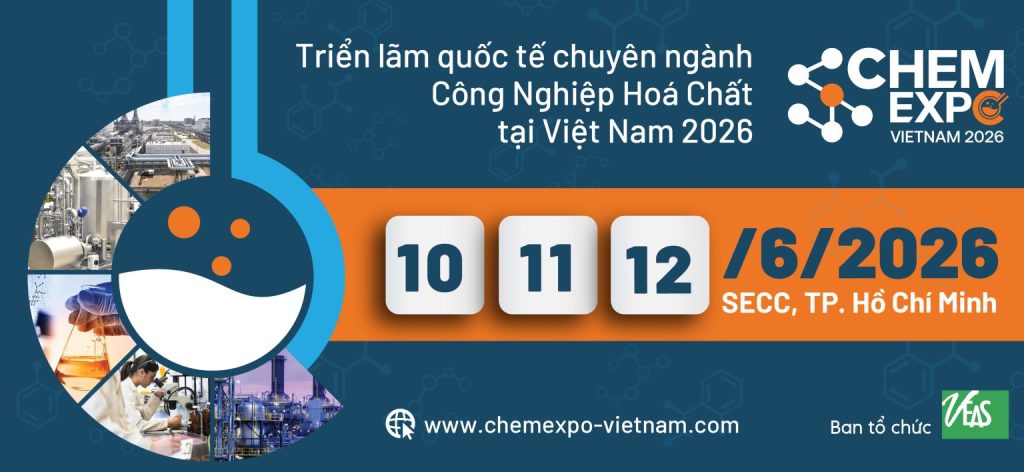
To directly experience and stay updated on the latest trends in the chemical industry, join ChemExpo Vietnam 2026 – the leading trade exhibition for Vietnam’s chemical sector.
The event brings together hundreds of domestic and international enterprises showcasing cutting-edge technologies, new materials, advanced production equipment, and green, smart, and sustainable solutions.
At ChemExpo, you will have the opportunity to:
-
Meet leading experts in chemistry, technology, AI, and ESG.
-
Discover real-world innovations from pioneering brands.
-
Connect with partners, expand your network, and explore collaboration opportunities.
ChemExpo Vietnam 2026 – Where technology, innovation, and sustainability converge for the future of Vietnam’s chemical industry.
Visit https://checkin.veas.com.vn/book-a-stand/PRC2027/forms/chemex?locale=en to register your visit and stay updated with the latest event information!
Nguồn tham khảo:
United States Environmental Protection Agency. “Basics of Green Chemistry.” US EPA, 4 Feb. 2025, www.epa.gov/greenchemistry/basics-green-chemistry.
Zeidler, Vânia Zuin. “Digitalization Paving the Ways for Sustainable Chemistry: Switching on More Green Lights.” Science, vol. 384, no. 6701, 13 June 2024, https://doi.org/10.1126/science.adq3537. Accessed 27 Apr. 2025.
StartUs Insights. “Top 10 Chemical Industry Trends (2026) | StartUs Insights.” StartUs Insights, 18 July 2025, www.startus-insights.com/innovators-guide/chemical-industry-trends/?utm. Accessed 4 Nov. 2025.
Nikhil Kaitwade. “Nanoscale Chemicals Market Growth – Trends & Forecast 2025 to 2035.” Futuremarketinsights.com, 10 Apr. 2025, www.futuremarketinsights.com/reports/nanoscale-chemicals-market. Accessed 4 Nov. 2025.
“IoT in Chemical Market.” Market.us, Apr. 2025, market.us/report/iot-in-chemical-market/. Accessed 4 Nov. 2025.
“Artificial Intelligence (AI) in the Chemicals Market Report 2032.” Www.precedenceresearch.com, www.precedenceresearch.com/artificial-intelligence-in-the-chemical-market.